
In the world of plugins, few battles are as legendary as this one. In one corner, you have the indie champion, the undisputed king of character and vibe, beloved by artists and producers for its instant mojo and unbelievable price. In the other, the technical master, the surgeon of sonic space, revered by mixing engineers for its pristine sound and unparalleled control.
This is more than a simple reverb review; this is a title fight for the ages.
For years, producers have asked the same question: when it’s time to invest in a top-tier algorithmic reverb plugin, do you go with Valhalla VintageVerb or FabFilter Pro-R 2? Both are S-Tier, but they are fundamentally different beasts, born from different philosophies. Choosing the wrong one for your workflow isn’t just a matter of taste; it can be a costly mistake that slows down your creative process.
Today, we settle the debate. We’re breaking down the sound, the workflow, and the core identity of each of these titans to help you finally decide which reverb to buy. This is the definitive Valhalla VintageVerb vs Pro-R 2 showdown.
Let’s get ready to rumble.
In This Corner: Valhalla VintageVerb, The Vibe King
The Pitch: For instant character, lush color, and classic sounds, Valhalla VintageVerb is the fastest gun in the west.
Valhalla DSP, the company behind VintageVerb, has built a legendary reputation on two things: incredible sound quality and an almost laughably fair price point. VintageVerb is the flagship example of this ethos. It doesn’t try to be a realistic room simulator. Instead, it proudly wears its digital heart on its sleeve, emulating the sought-after hardware reverb units of the 1970s and 1980s. This plugin isn’t about creating subtle, believable spaces; it’s about making a statement.
The Sound: Why It’s the Go-To Plugin for Vocal Reverb
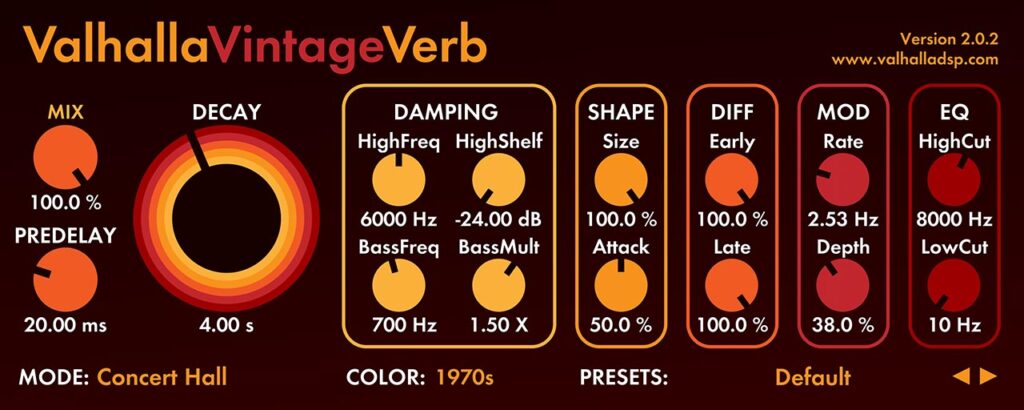
The first thing you notice about VintageVerb is its sound: it’s dense, rich, and dripping with character. This is the sound you’ve heard on countless records. The plugin comes loaded with 19 distinct reverb algorithms, each with a unique personality.
The “Concert Hall” mode is perfect for creating massive, epic spaces for a synth lead, while the “Plate” setting delivers that classic, shimmery texture that makes a perfect vocal reverb for pop and rock. The “Sanctuary” algorithm is another standout, capable of creating impossibly vast, atmospheric washes of sound that are a dream for ambient producers.
What truly sets it apart are the “Color” modes. You can choose “1970s” for a darker, grittier reverb with reduced bandwidth, “1980s” for a brighter, more modulated character, or “NOW” for a clean, modern take. This simple switch allows you to instantly place your sound in a different era, making it an incredibly powerful and fast sound design tool.
The Workflow: A Masterclass in Simplicity
In a world of complex plugins with dozens of tabs and hidden menus, VintageVerb is a breath of fresh air. The interface is famously simple and completely resizable. Everything you need is on one screen, presented with clean text and simple sliders.
The primary controls—Mix, PreDelay, and Decay—are front and center. The Decay can go all the way up to 70 seconds for truly massive spaces.
Below that, you have a simple EQ section for damping the high and low frequencies of the reverb tail, which is crucial for preventing a muddy mix. This simplicity is its greatest strength. It encourages you to use your ears, not your eyes. You aren’t paralyzed by a thousand options; you’re inspired by a few great-sounding ones. You can dial in a world-class sound in under 30 seconds, which is a workflow miracle when creativity is flowing.
The Verdict: The Best Value Algorithmic Reverb Plugin?
Let’s talk about the price: it’s $50. That’s not a subscription, that’s not a limited-time offer—that’s the price. For the quality and character you get, it is without a doubt one of the best values in the entire plugin industry. It’s a complete no-brainer for producers who want that iconic, stylized reverb sound without a huge investment. For sheer vibe, speed, and inspirational power, it’s almost impossible to beat.
And in This Corner: FabFilter Pro-R 2, The Sonic Surgeon
The Pitch: For pristine, realistic spaces and unparalleled surgical control, FabFilter Pro-R 2 is in a league of its own.
If Valhalla is the passionate artist, FabFilter is the brilliant surgeon. The company is renowned for creating plugins that are as beautiful to look at as they are powerful to use, combining stunning design with deep, professional functionality. Pro-R 2 is the embodiment of this philosophy. It’s not concerned with emulating old, quirky hardware. Instead, it aims to give you the cleanest, most natural-sounding reverb possible, with an unprecedented level of control.
The Sound: Crafting a Natural and Clean Drum Reverb
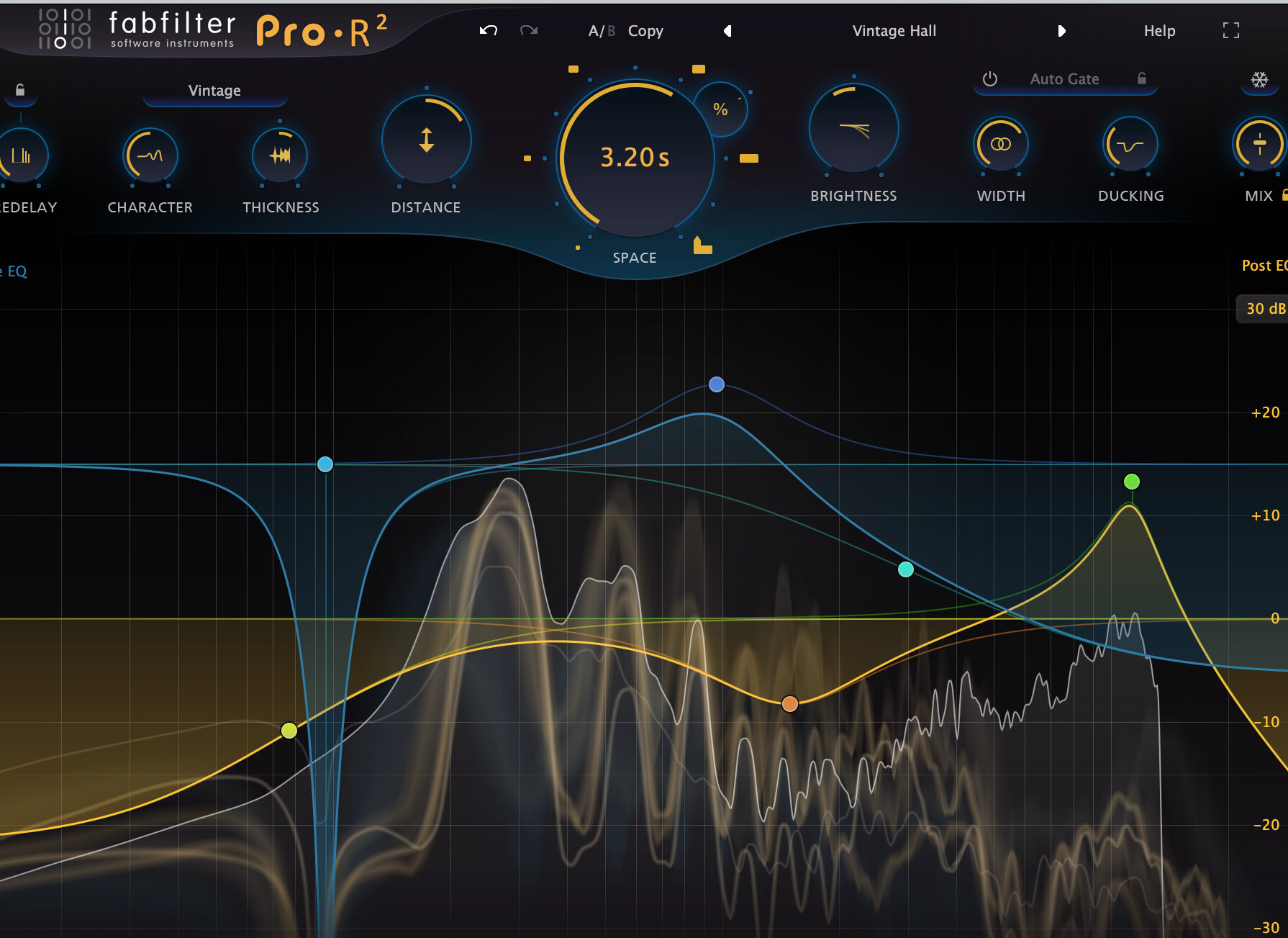
The sound of Pro-R 2 can be described in one word: pristine. It is exceptionally clean and uncolored, allowing you to create incredibly realistic spaces that blend seamlessly into a mix. Instead of technical terms like “diffusion” or “modulation,” Pro-R 2 uses intuitive, musical controls like “Brightness,” “Character,” and a “Distance” knob that smoothly moves a sound from the front of the room to the back.
This makes it a top choice for any task that demands realism. If you’re mixing a delicate acoustic guitar, a soulful piano, or creating a subtle drum reverb to place an acoustic kit in a believable space, Pro-R 2 is your tool. It can create small, intimate rooms with the same authority as it creates large, open halls, all while respecting the integrity of your original source sound. It’s a contender for the best reverb VST precisely because it doesn’t impose its own character unless you ask it to.
The Workflow: Why It Could Be the Best Reverb VST for Mixers
The workflow is where Pro-R 2 truly enters a class of its own. The interface is gorgeous, featuring a large, interactive frequency display. But the game-changing features are the Decay Rate EQ and Post-EQ. The Decay Rate EQ is a revolutionary concept; it allows you to set different decay times for different frequency ranges.
For example, you can make the low frequencies of your reverb decay very quickly to avoid mud, while letting the high frequencies ring out for a beautiful, airy tail. This level of control is simply not available in most other reverbs.
On top of that, a full-featured 6-band Post-EQ is built directly into the plugin, allowing you to shape the final reverb sound with the same surgical precision as FabFilter’s legendary Pro-Q 3. This combination of features makes Pro-R 2 an indispensable tool for professional mixing engineers who need to solve problems and perfectly sculpt the space around an instrument.
The Verdict: The Price of Ultimate Control
Pro-R comes with a premium price tag, and for good reason. It’s a professional investment for producers and engineers who need the absolute cleanest sound and the most precise control imaginable. The intuitive design masks a deeply powerful and complex engine. For mixers who need to solve problems and create perfect, transparent spaces, Pro-R 2 is an essential, S-Tier tool.
The Final Verdict: Which Reverb Plugin Should You Buy?
At the end of this reverb review, we have to answer the main question: in the battle of Valhalla VintageVerb vs Pro-R 2, which one comes out on top? The truth is, the winner depends entirely on you.
Choose Valhalla VintageVerb If…
You are an artist or producer who wants instant vibe, color, and character. If you produce synth-heavy music like synthwave, ambient, or EDM, or if you want that lush, dreamy sound for pop vocals, VintageVerb will feel like a creative partner. If you value speed and simplicity over deep, surgical tweaking, and if your budget is under $100, this is your champion.
Choose FabFilter Pro-R 2 If…
You are a mixing engineer or a producer who needs clean, natural, and realistic-sounding spaces. If you work with acoustic instruments, film scores, or any genre where realism is key, Pro-R 2 is the superior choice. If you want deep, surgical control over every aspect of your reverb tail and view plugins as a long-term professional investment, Pro-R 2 is the undisputed king.
Conclusion: There’s No Wrong Answer, Only the Right Tool
At the end of this Valhalla VintageVerb vs Pro-R 2 showdown, there’s no single knockout. Both champions remain standing. The real winner is you, because you now know exactly which one fits your corner.
The best reverb VST is the one that gets you the sound in your head the fastest. Whether you’re a vibe-chasing artist who wants to be inspired or a precision-minded engineer who needs to solve problems, one of these legendary plugins is your perfect match.
Which reverb champion is in your corner? Did we get it right? Fight it out in the comments below!